Prompt 1
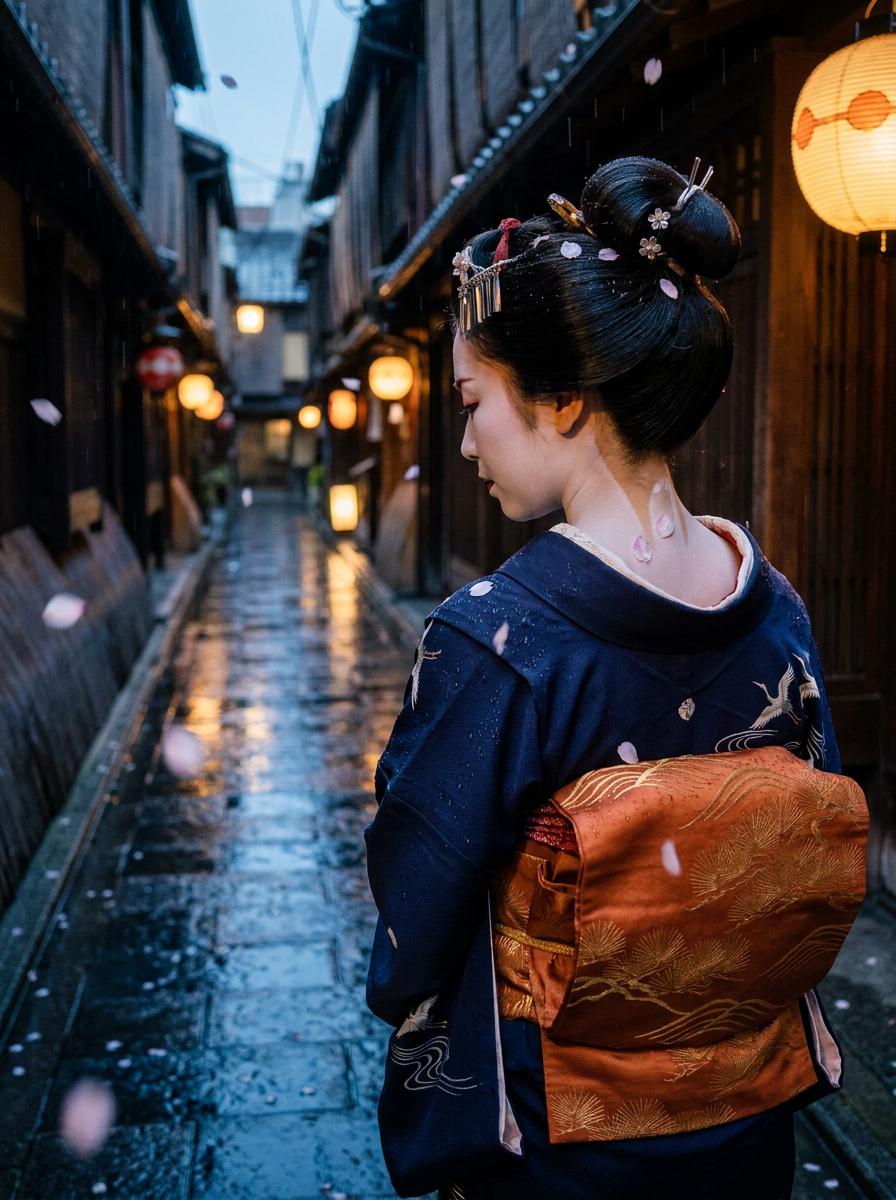
Use the provided reference image as the visual identity reference for a photorealistic 2:3 vertical cinematic documentary-fashion portrait. Create an adult Kyoto geiko walking away through a narrow lantern-lit alley during light spring rain and falling cherry blossoms. Preserve the subject as a real adult Japanese woman with grounded human proportions, traditional Kyoto styling, and no fantasy, anime, costume-party, or tourist-postcard treatment. No readable text, no logos, no watermarks, no poster layout. Place her in a narrow Pontocho-style Kyoto alley at the transition from golden hour into blue hour, with old dark wooden machiya facades on both sides, warm paper lanterns hanging at uneven heights, wet blue-black stone paving, and shallow rainwater reflecting amber light in long broken streaks. The alley recedes into a soft one-point perspective toward the upper-left background. Keep the environment intimate, damp, and compressed, with no crowds, no modern signage, no readable shop names, and no decorative clutter. Shoot from a rear three-quarter documentary distance, slightly behind and to her right, close enough to see the nape makeup, obi structure, hair ornaments, and silk texture, but not so close that the alley disappears. Use a 50mm documentary-editorial perspective with natural handheld framing, subject placed along the right third, walking away from the camera toward the alley depth. Crop from above the hair ornaments to below the lower kimono hem, allowing the wet stones, lantern reflections, and falling petals to create layered depth around her. Her head turns only a few degrees into profile, revealing a narrow sliver of painted cheek, the curve of one ear, lowered lashes, and the smallest edge of a muted crimson lip. She does not look at the camera. Her gaze stays lowered toward the wet stones ahead, expression quiet, inward, and unavailable. The body remains composed and formal, with small walking movement visible in the kimono hem and sleeve fall, not a posed fashion stance. Make the nape of the neck one of the main visual anchors. Show traditional white shironuri makeup around the back of the neck with a clear three-pronged sanbon-ashi pattern of natural warm skin left unpainted at the nape. Fine baby hairs are visible along the hairline, and one wet cherry blossom petal clings to the exposed natural-skin area. Small rain droplets bead on the white makeup and along the hairline without smearing the makeup. Style her hair in a traditional glossy black shimada-style chignon viewed from the back, with visible woven structure, smooth tension, and a few individual strands catching lantern light. Add a vintage tortoiseshell kanzashi comb and delicate silver bira-bira pins with tiny flower shapes, positioned securely in the hair. A few pale pink petals rest naturally in the hair, caught between the pinned sections rather than floating unrealistically. Dress her in a deep midnight-indigo silk kimono with a traditional collar line and grounded sleeve weight. The back of the kimono shows a restrained painted motif of cranes in flight over silver river lines, visible enough to read but not so busy that it competes with the obi. The silk catches small rain droplets that bead on the surface and collect along fold ridges. A single cherry blossom petal rests on one shoulder. The obi is the central garment architecture: a burnt-orange silk obi with gold-thread woven pine-needle and wave patterns, tied in a structured taiko-musubi bow across the back. The bow should show real folded planes, knot thickness, woven thread texture, and believable tension where the obi wraps around the waist. The obi must read as a real tied garment, not a flat decorative panel or fantasy sash. Lighting hierarchy: cool blue-hour ambient light falls from above and fills the alley shadows, while warm amber lantern light rims the right side of her hair, cheek profile, nape, obi edge, sleeve folds, and wet stones. The lantern glow diffuses softly through mist and rain but should not become magical or overly hazy. Preserve small shadows under the obi bow folds, inside the kimono collar, beneath the chignon, between hair ornaments, along the nape makeup pattern, and in the wet stone joints. Petal and rain hierarchy: use a real layered cherry-blossom fall with a few large foreground petals motion-blurred near the lens, several midground petals sharp around her hair, shoulder, and obi, and softer pink flecks receding into the alley. The rain appears as fine vertical streaks in the lantern light and soft specks against the dark wood. Keep the petals wind-tossed but physically plausible, not a fantasy storm. Palette hierarchy: hero colors deep midnight indigo and burnt-orange silk, support colors warm amber lantern light, pale white shironuri makeup, natural warm nape skin, glossy black hair, and soft pink petals. Restraint colors are wet blue-black cobblestones, dark cedar wood, silver river motifs, tortoiseshell brown, muted crimson lip, and cool blue-gray rain shadow. Keep the palette cinematic and restrained, with rich shadow detail and no neon saturation. Object hierarchy: primary focus is the exposed nape with sanbon-ashi makeup, the burnt-orange taiko obi, and the turned-away profile sliver. Secondary focus is the glossy shimada hair, kanzashi ornaments, midnight-indigo kimono silk, rain droplets, and petal caught on the nape. Tertiary supports are wet stone reflections, warm lanterns, machiya wood, foreground petal blur, alley perspective, and soft rain haze. Edge activity: dominant edge pressure comes from dark wooden alley walls compressing both sides of the vertical frame and cherry petals crossing the foreground. Secondary edge pressure comes from the subject placed on the right third, the obi bow projecting into the center of the frame, and the alley vanishing point pulling away toward the upper-left. Keep the frame slightly asymmetrical and candid, with a gentle handheld imperfection but no extreme dutch tilt. The final image should read as a quiet Kyoto documentary-fashion moment: an adult geiko walking away through wet lantern light, exposed sanbon-ashi nape with one petal stuck to the skin, glossy shimada hair with kanzashi, burnt-orange taiko obi, midnight-indigo kimono, falling cherry blossoms, fine rain, and a narrow profile sliver that never meets the camera. Maintain realistic skin texture, accurate traditional makeup placement, believable kimono and obi construction, natural hair ornament placement, physically consistent rain and petal behavior, wet stone reflections, grounded Kyoto alley architecture, restrained cinematic film grain, and lens-realistic depth. Avoid fantasy geisha styling, cosplay costume fabric, incorrect obi geometry, front-facing portrait logic, direct camera gaze, magical petal storm, readable signs, tourist crowds, plastic skin, fake HDR, over-smoothed beauty lighting, CGI lantern glow, excessive saturation, and decorative clutter.
- Engine
- nano-banana
- Dimension
- portrait_4_3
- Gender
- female
- Age
- any