8 templates · Nano Banana 2
8 Nano Banana 2 mannequin templates to try with your character
Keep the scene and change the character. These NB2 examples use a green mannequin to guide the pose, body shape, outfit and setting, with a separate photo for identity. Separating the two references helps reduce identity drift.
Choose a look, upload one photo, and tap Remix.
How to use a mannequin template
Use two separate inputs
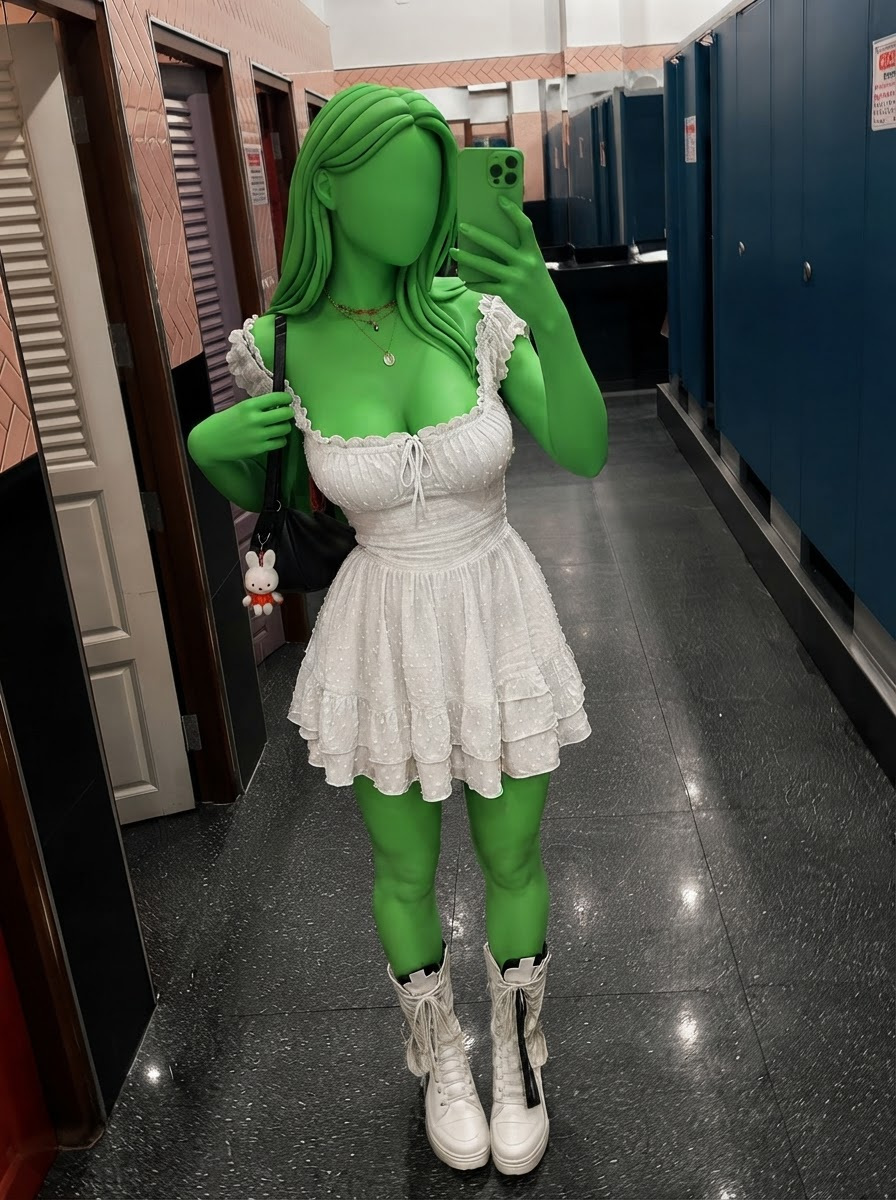
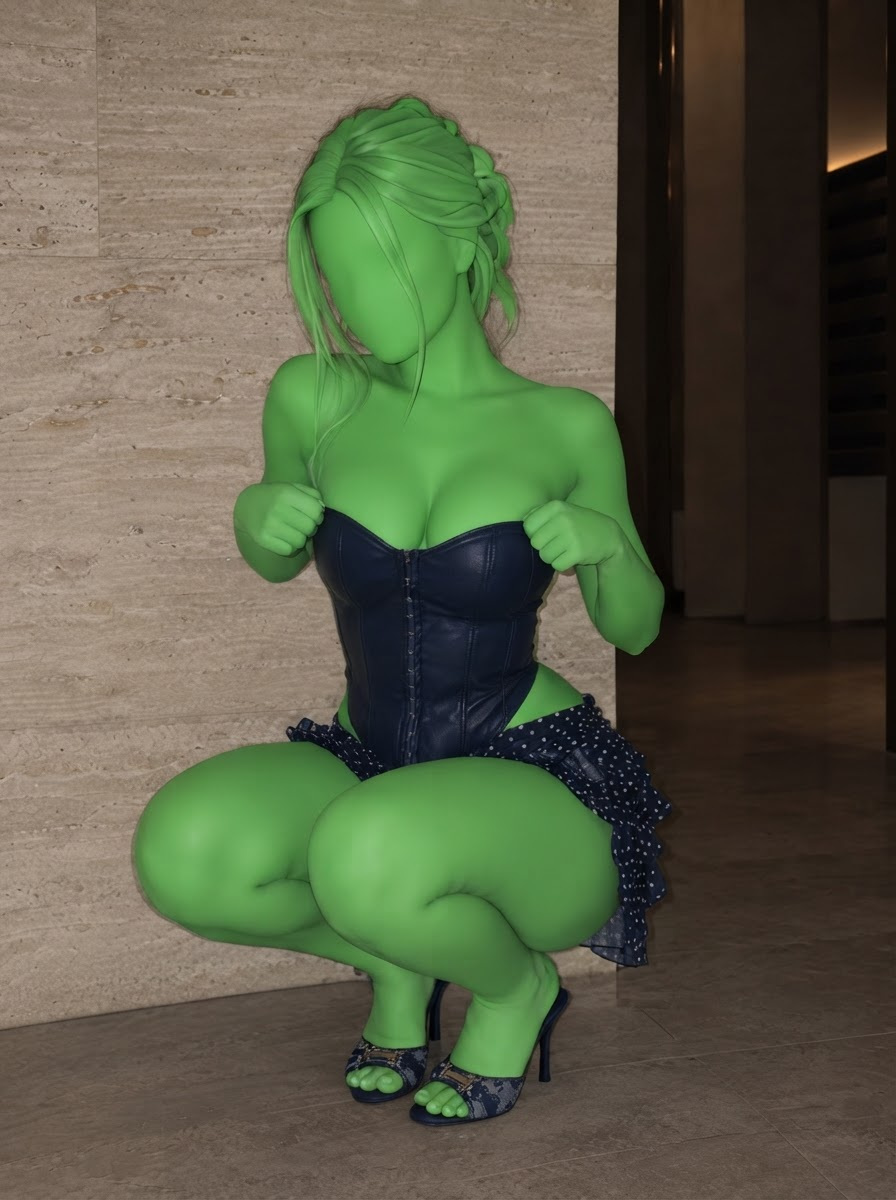
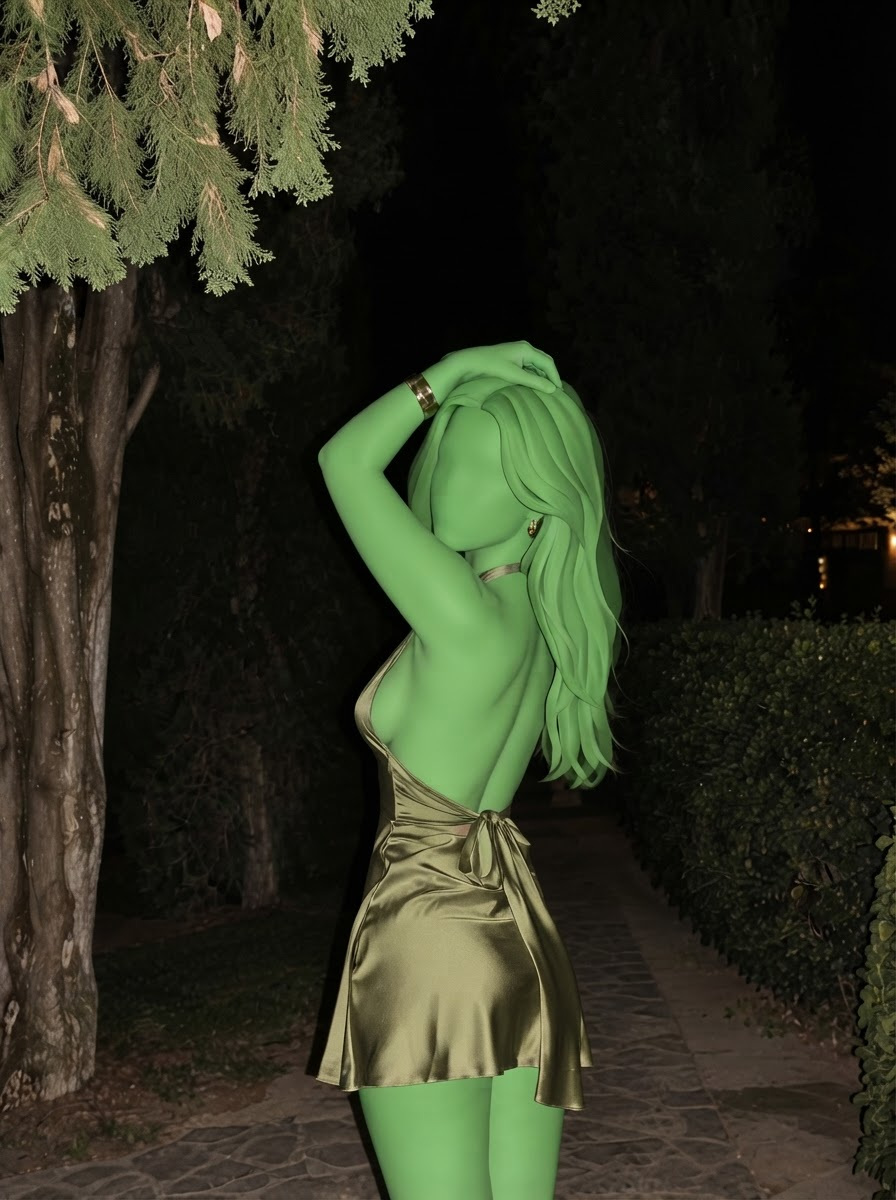
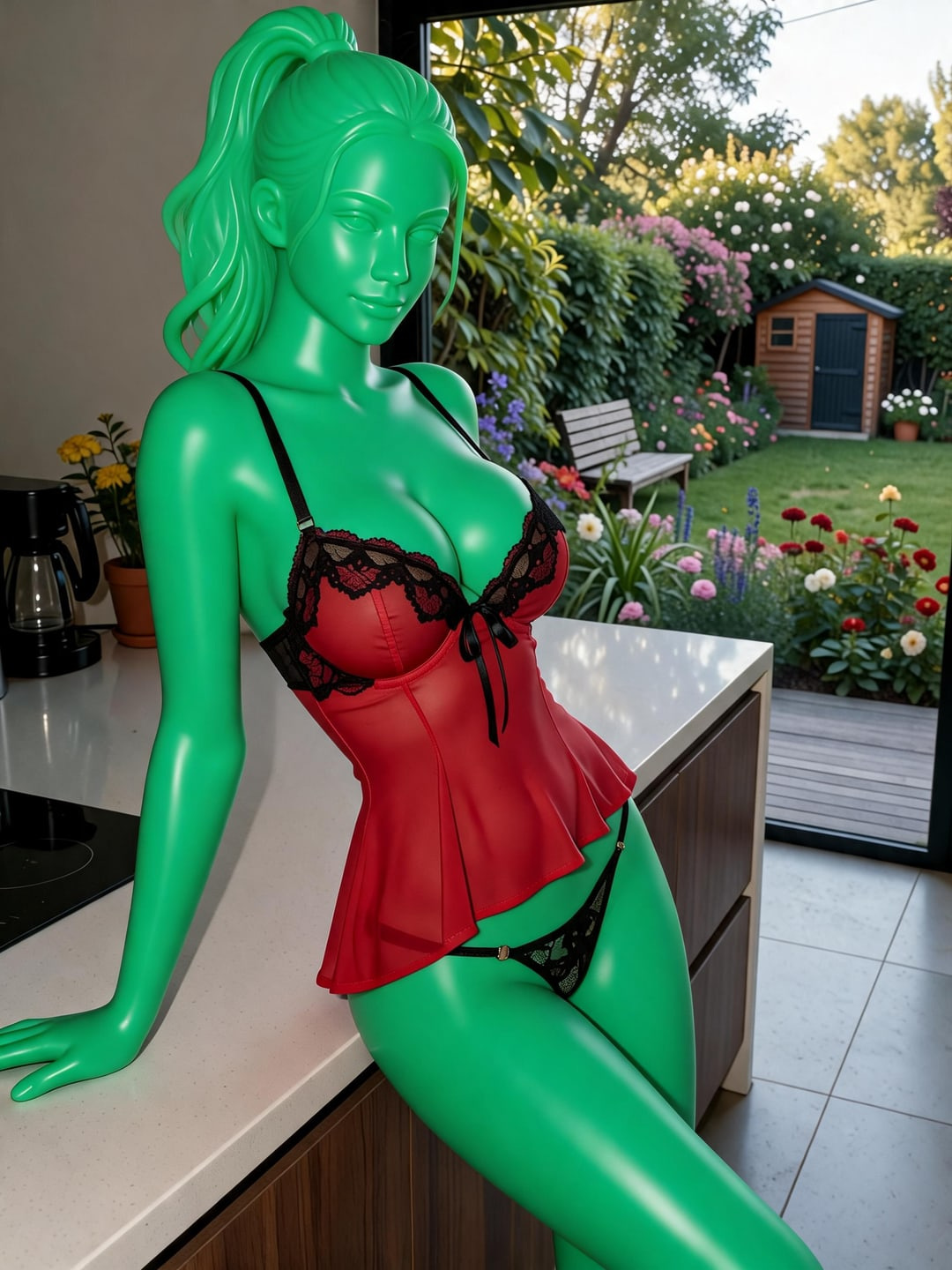
Image 1 is the green template for pose, proportions, outfit and setting. Image 2 is a clear photo of your adult character for identity.
Generate with NB2
Use both images with the prompt linked below each example. Or open the pack on remix.camera, upload your character and tap Remix.
Check the result
Check the face, hands, hair and clothing. Keep a clear identity photo and retry any output where the face or body drifts.
Mila and Lily results, with the templates that made them
Each example shows a finished character result followed by its green mannequin template. To try one, use the template as Image 1 and a photo of your own adult character as Image 2 with the included prompt. Or open the pack, upload your character photo, and tap Remix.
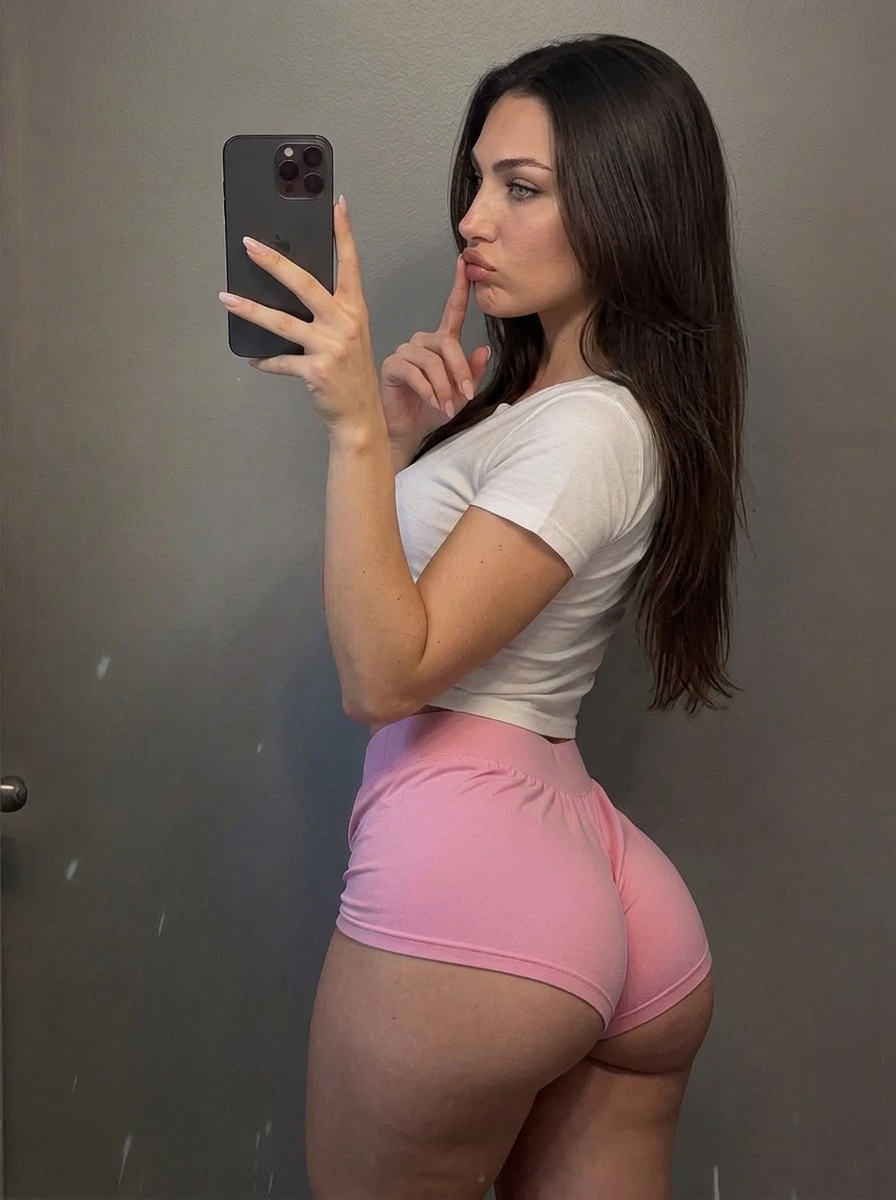
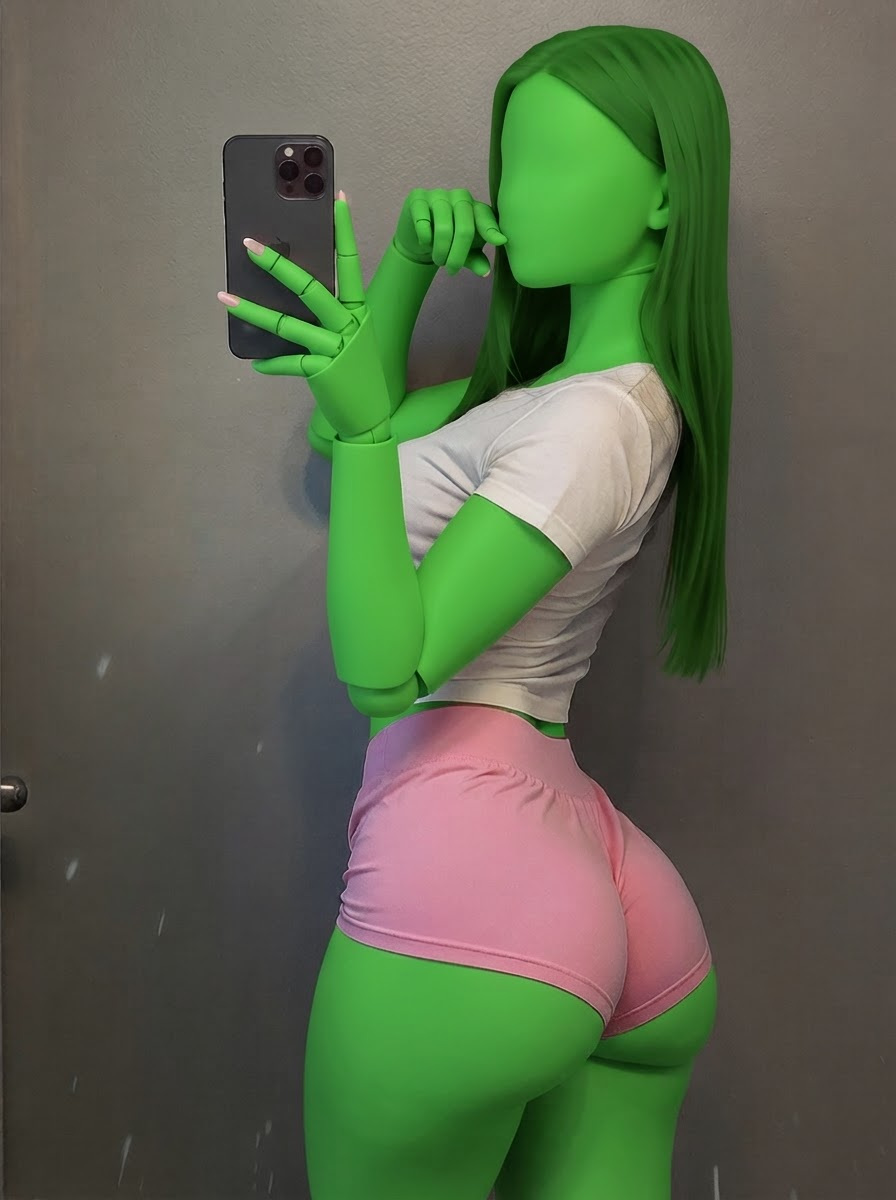 Open template
White tee and pink shorts
View the full NB2 prompt
A scene featuring the woman in the uploaded reference image (DO NOT TOUCH FACE). Image 1 is the identity-neutral chroma-green scene template. Image 2 is the identity reference for Lily. Facial construction: build the complete primary face solely from Lily's identity in Image 2. Image 1's perfectly blank head supplies only head position, scale, yaw, pitch, roll, and neck attachment. It supplies no face shape, facial proportions, features, gaze, or expression. Apply the Face description below to Lily's facial identity from Image 2; do not infer or average facial anatomy from Image 1. Pose authority: Image 1 controls all scene geometry. Preserve the primary subject's exact shoulder line, neck rotation, head yaw, head pitch, and head roll from Image 1 even when they differ from Image 2. The frozen Face description controls gaze and expression on the Image 2 identity. Never straighten, front-face, recenter, or otherwise normalize the head pose to match Image 2. Scene: A woman stands in profile against a plain gray wall, holding a smartphone in her right hand to take a mirror selfie. Her left hand is raised to her lips, and she is wearing a t-shirt and pink shorts. Wardrobe: The subject is wearing a short-sleeved t-shirt and tight pink athletic shorts. Face: The subject's head is turned in profile toward the viewer's left with a pouting mouth expression. Her eyes are open and directed toward the mirror, with relaxed brows and smooth cheeks. Wardrobe: The subject is wearing a short-sleeved t-shirt and tight pink athletic shorts. Preserve every visible garment and footwear item exactly. Wardrobe geometry authority: Image 1 controls the exact neckline depth and shape, strap placement, visible cleavage and coverage, bust contour created by the garment, hem, fit, fabric tension, and overlap. Do not raise, flatten, widen, or redesign the garment. Wardrobe appearance authority: preserve the garment colors, patterns, sheen, opacity, and fabric texture visible in Image 1; never treat clothing as mannequin material. Hair authority: Image 1 controls hairstyle geometry and style, including length, silhouette, part line, root direction, volume, layered sections, bangs, braids or tied sections, wave or curl groups, separated locks, overlaps, tapered ends, and whether the hair is worn up or down. Image 2 controls the target subject's hair color and identity. Interpret every chroma-green hair section as a geometry guide, not as a solid object. Reconstruct complete photorealistic natural hair with continuous strands and fine texture while preserving the guided section placement and flow. Never return the target subject bald, and never leave a helmet, cap, slab, wedge, faceted polygon shell, or blocky low-poly hair shape. Replace only the primary chroma-green mannequin completely with Lily from Image 2. Replace every secondary chroma-green mannequin with a separate, distinct new adult identity that broadly preserves that secondary subject's visible styling, clothing state, pose, scale, and scene role. Never copy or duplicate Lily onto a secondary person. Use Image 2 exclusively for facial identity, facial proportions, skin, eye appearance, and hair color. Do not copy any normalized mannequin facial proportions as identity, and do not reconstruct the original source person's identity. Match the stated action, camera relationship, face, hand positions and interactions, visible object inventory, person count, pose, crop, clothing state, lighting, background, and composition. Do not add an implied phone, camera, mirror, held prop, person, garment, or text that the Scene does not show. Remove all chroma-green mannequin material, green spill, plastic texture, blank-face artifacts, and placeholder traces from every subject. Preserve legitimate green scene objects and clothing. Photorealistic, natural skin texture, anatomically coherent hands and body, no text.
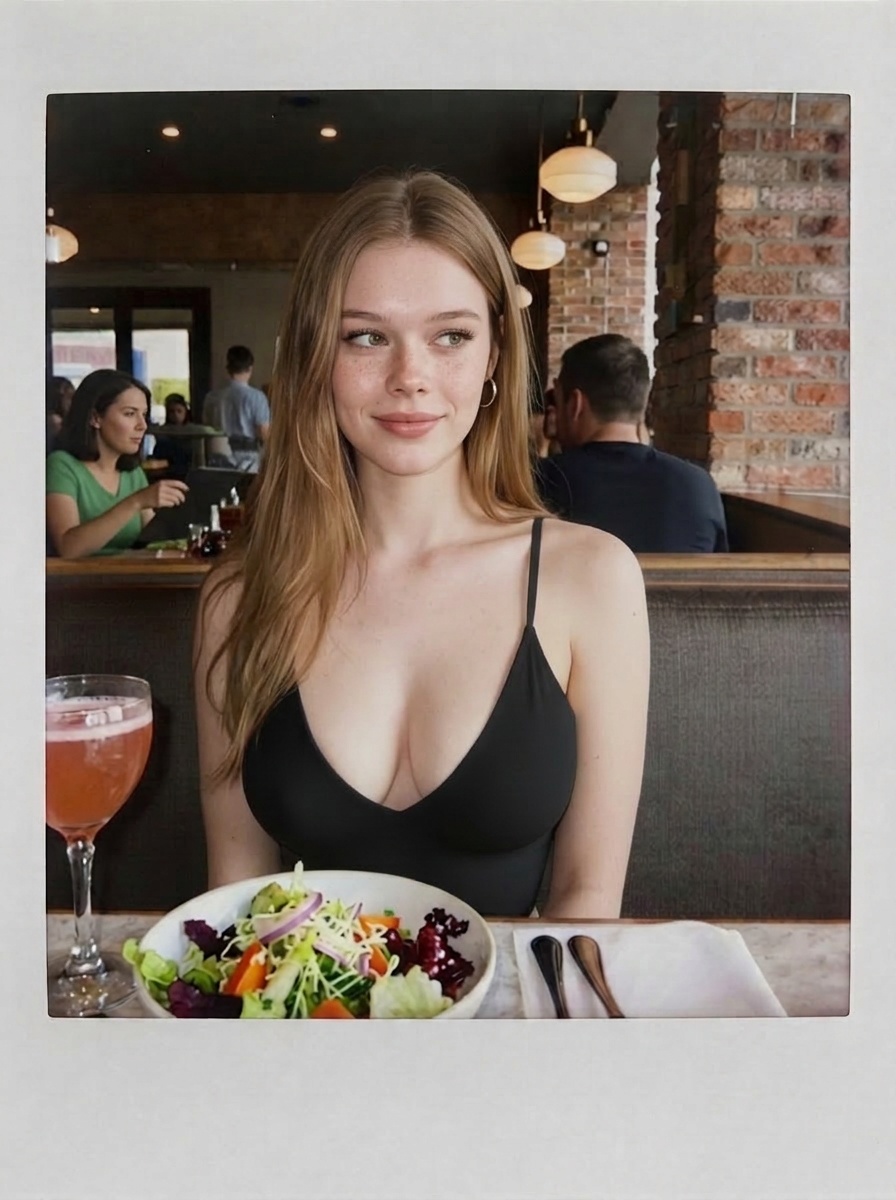
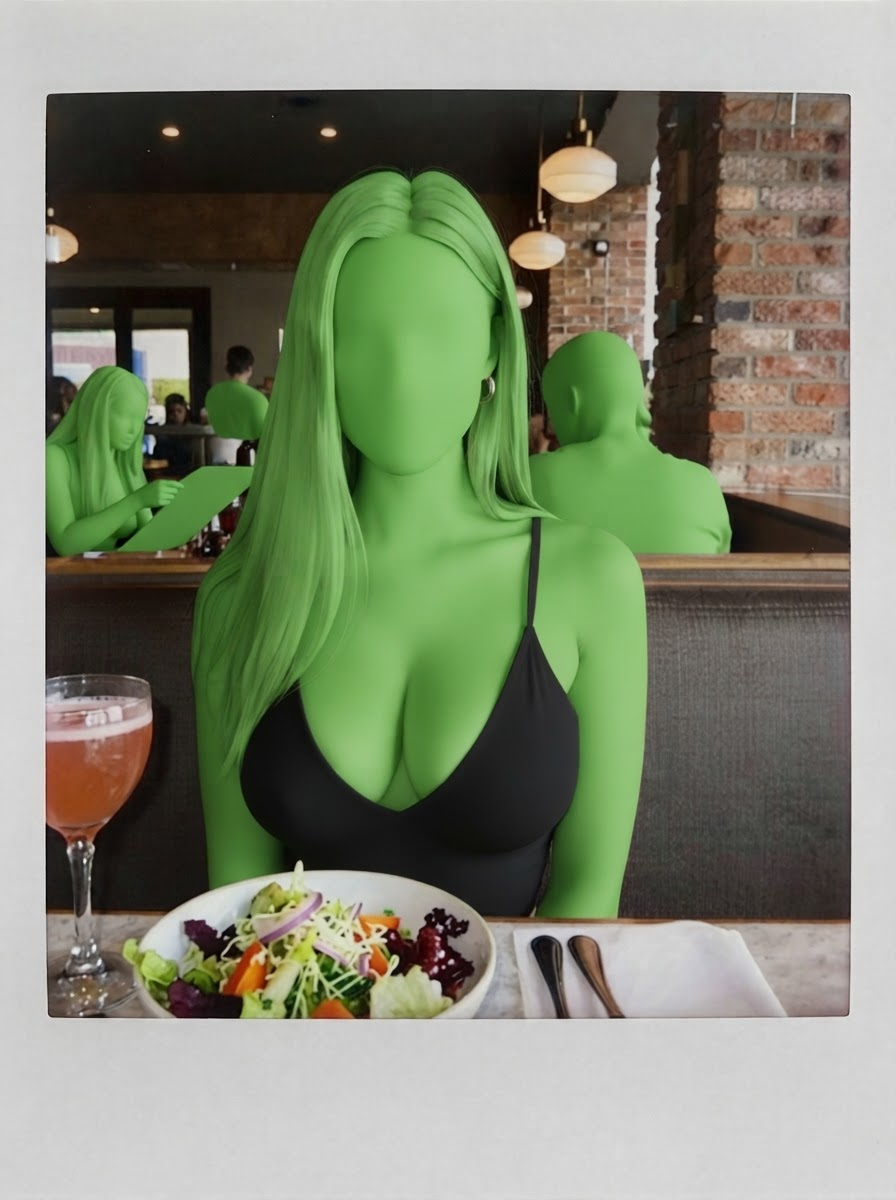 Open template
Lunch at a restaurant
View the full NB2 prompt
A scene featuring the woman in the uploaded reference image (DO NOT TOUCH FACE). Image 1 is the identity-neutral chroma-green scene template. Image 2 is the identity reference for Mila. Facial construction: build the complete primary face solely from Mila's identity in Image 2. Image 1's perfectly blank head supplies only head position, scale, yaw, pitch, roll, and neck attachment. It supplies no face shape, facial proportions, features, gaze, or expression. Apply the Face description below to Mila's facial identity from Image 2; do not infer or average facial anatomy from Image 1. Pose authority: Image 1 controls all scene geometry. Preserve the primary subject's exact shoulder line, neck rotation, head yaw, head pitch, and head roll from Image 1 even when they differ from Image 2. The frozen Face description controls gaze and expression on the Image 2 identity. Never straighten, front-face, recenter, or otherwise normalize the head pose to match Image 2. Scene: A woman sits at a restaurant table with a salad and a cocktail, facing forward while looking toward the viewer's right. The background shows a dimly lit dining area with other patrons and brick walls. Wardrobe: The subject is wearing a spaghetti-strap top. Face: The subject has a slight smile with closed lips, and her gaze is directed toward the viewer's right. Her head is tilted slightly, and her brows are relaxed. Wardrobe: The subject is wearing a spaghetti-strap top. Preserve every visible garment and footwear item exactly. Wardrobe geometry authority: Image 1 controls the exact neckline depth and shape, strap placement, visible cleavage and coverage, bust contour created by the garment, hem, fit, fabric tension, and overlap. Do not raise, flatten, widen, or redesign the garment. Wardrobe appearance authority: preserve the garment colors, patterns, sheen, opacity, and fabric texture visible in Image 1; never treat clothing as mannequin material. Hair authority: Image 1 controls hairstyle geometry and style, including length, silhouette, part line, root direction, volume, layered sections, bangs, braids or tied sections, wave or curl groups, separated locks, overlaps, tapered ends, and whether the hair is worn up or down. Image 2 controls the target subject's hair color and identity. Interpret every chroma-green hair section as a geometry guide, not as a solid object. Reconstruct complete photorealistic natural hair with continuous strands and fine texture while preserving the guided section placement and flow. Never return the target subject bald, and never leave a helmet, cap, slab, wedge, faceted polygon shell, or blocky low-poly hair shape. Replace only the primary chroma-green mannequin completely with Mila from Image 2. Replace every secondary chroma-green mannequin with a separate, distinct new adult identity that broadly preserves that secondary subject's visible styling, clothing state, pose, scale, and scene role. Never copy or duplicate Mila onto a secondary person. Use Image 2 exclusively for facial identity, facial proportions, skin, eye appearance, and hair color. Do not copy any normalized mannequin facial proportions as identity, and do not reconstruct the original source person's identity. Match the stated action, camera relationship, face, hand positions and interactions, visible object inventory, person count, pose, crop, clothing state, lighting, background, and composition. Do not add an implied phone, camera, mirror, held prop, person, garment, or text that the Scene does not show. Remove all chroma-green mannequin material, green spill, plastic texture, blank-face artifacts, and placeholder traces from every subject. Preserve legitimate green scene objects and clothing. Photorealistic, natural skin texture, anatomically coherent hands and body, no text.
 Open template
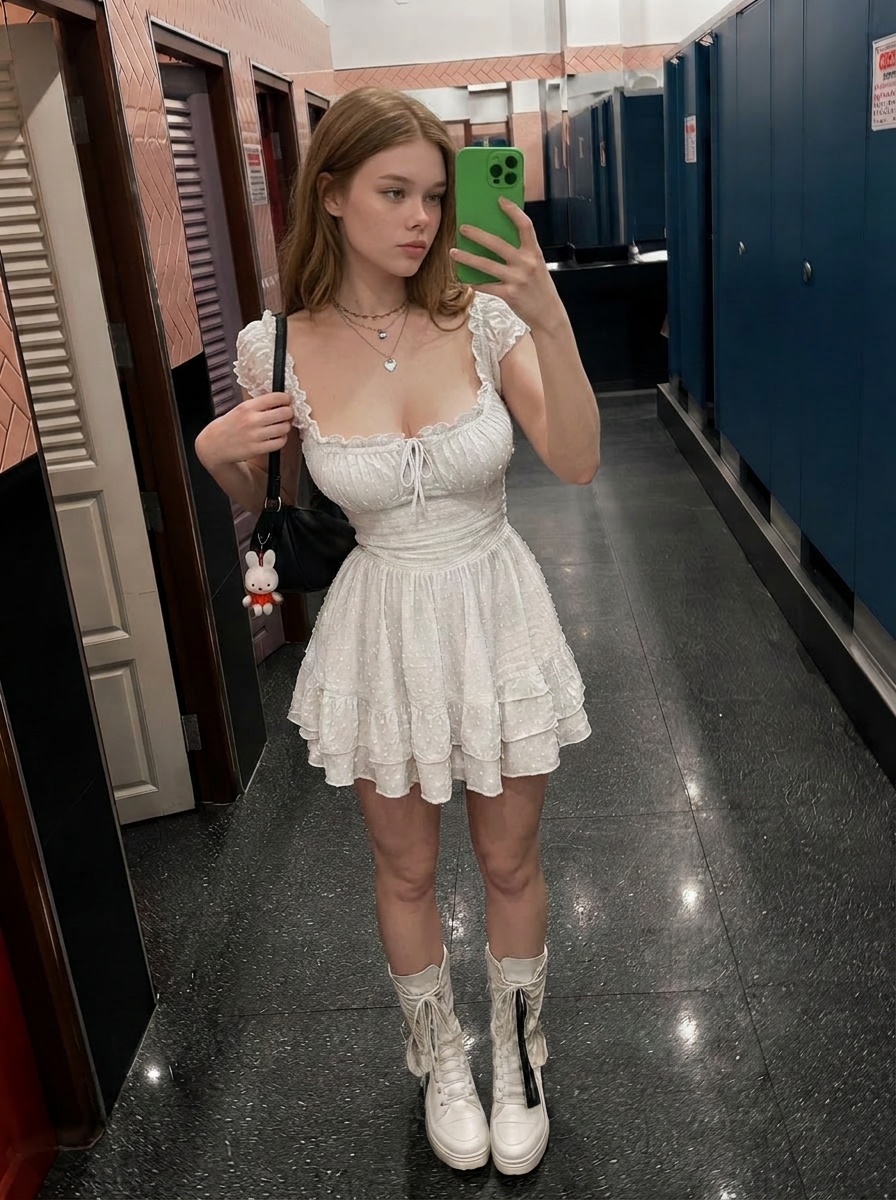
White ruffled dress mirror selfie
View the full NB2 prompt
A scene featuring the woman in the uploaded reference image (DO NOT TOUCH FACE). Image 1 is the identity-neutral chroma-green scene template. Image 2 is the identity reference for Mila. Facial construction: build the complete primary face solely from Mila's identity in Image 2. Image 1's perfectly blank head supplies only head position, scale, yaw, pitch, roll, and neck attachment. It supplies no face shape, facial proportions, features, gaze, or expression. Apply the Face description below to Mila's facial identity from Image 2; do not infer or average facial anatomy from Image 1. Pose authority: Image 1 controls all scene geometry. Preserve the primary subject's exact shoulder line, neck rotation, head yaw, head pitch, and head roll from Image 1 even when they differ from Image 2. The frozen Face description controls gaze and expression on the Image 2 identity. Never straighten, front-face, recenter, or otherwise normalize the head pose to match Image 2. Scene: A woman stands in a public restroom corridor, holding a smartphone in her right hand to take a mirror selfie. She is positioned centrally, wearing a ruffled dress and lace-up boots, with a shoulder bag hanging from her left shoulder. Wardrobe: The subject is wearing a, short-sleeved, ruffled mini dress with a textured pattern and lace-up combat boots. Face: The subject's head is slightly tilted toward her left, with a neutral, relaxed expression. Her eyes are open and directed toward the mirror, her mouth is closed, and her facial muscles appear relaxed. Wardrobe: The subject is wearing a, short-sleeved, ruffled mini dress with a textured pattern and lace-up combat boots. Preserve every visible garment and footwear item exactly. Wardrobe geometry authority: Image 1 controls the exact neckline depth and shape, strap placement, visible cleavage and coverage, bust contour created by the garment, hem, fit, fabric tension, and overlap. Do not raise, flatten, widen, or redesign the garment. Wardrobe appearance authority: preserve the garment colors, patterns, sheen, opacity, and fabric texture visible in Image 1; never treat clothing as mannequin material. Hair authority: Image 1 controls hairstyle geometry and style, including length, silhouette, part line, root direction, volume, layered sections, bangs, braids or tied sections, wave or curl groups, separated locks, overlaps, tapered ends, and whether the hair is worn up or down. Image 2 controls the target subject's hair color and identity. Interpret every chroma-green hair section as a geometry guide, not as a solid object. Reconstruct complete photorealistic natural hair with continuous strands and fine texture while preserving the guided section placement and flow. Never return the target subject bald, and never leave a helmet, cap, slab, wedge, faceted polygon shell, or blocky low-poly hair shape. Replace only the primary chroma-green mannequin completely with Mila from Image 2. Replace every secondary chroma-green mannequin with a separate, distinct new adult identity that broadly preserves that secondary subject's visible styling, clothing state, pose, scale, and scene role. Never copy or duplicate Mila onto a secondary person. Use Image 2 exclusively for facial identity, facial proportions, skin, eye appearance, and hair color. Do not copy any normalized mannequin facial proportions as identity, and do not reconstruct the original source person's identity. Match the stated action, camera relationship, face, hand positions and interactions, visible object inventory, person count, pose, crop, clothing state, lighting, background, and composition. Do not add an implied phone, camera, mirror, held prop, person, garment, or text that the Scene does not show. Remove all chroma-green mannequin material, green spill, plastic texture, blank-face artifacts, and placeholder traces from every subject. Preserve legitimate green scene objects and clothing. Photorealistic, natural skin texture, anatomically coherent hands and body, no text.
 Open template
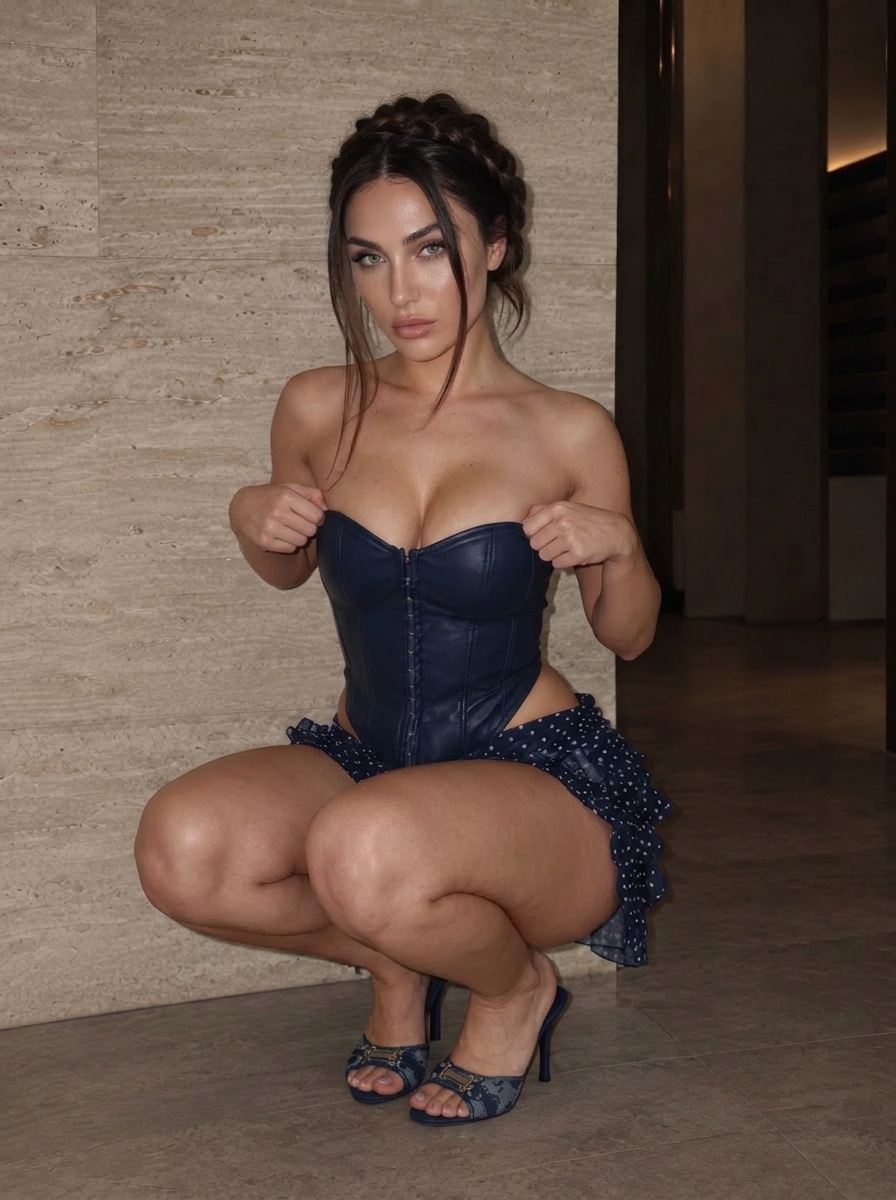
Blue strapless corset
View the full NB2 prompt
A scene featuring the woman in the uploaded reference image (DO NOT TOUCH FACE). Image 1 is the identity-neutral chroma-green scene template. Image 2 is the identity reference for Lily. Facial construction: build the complete primary face solely from Lily's identity in Image 2. Image 1's perfectly blank head supplies only head position, scale, yaw, pitch, roll, and neck attachment. It supplies no face shape, facial proportions, features, gaze, or expression. Apply the Face description below to Lily's facial identity from Image 2; do not infer or average facial anatomy from Image 1. Pose authority: Image 1 controls all scene geometry. Preserve the primary subject's exact shoulder line, neck rotation, head yaw, head pitch, and head roll from Image 1 even when they differ from Image 2. The frozen Face description controls gaze and expression on the Image 2 identity. Never straighten, front-face, recenter, or otherwise normalize the head pose to match Image 2. Scene: A woman is captured in a full-body squat against a textured stone wall in a dimly lit indoor setting. She is holding the top edge of her strapless corset with both hands, looking directly toward the camera. Wardrobe: The subject wears a dark blue strapless leather-style corset, a dark blue polka-dot mini skirt, and blue patterned high-heeled sandals. Face: The subject has a neutral, direct gaze with her head slightly tilted. Her mouth is closed with a soft expression, and her facial muscles appear relaxed. Wardrobe: The subject wears a dark blue strapless leather-style corset, a dark blue polka-dot mini skirt, and blue patterned high-heeled sandals. Preserve every visible garment and footwear item exactly. Wardrobe geometry authority: Image 1 controls the exact neckline depth and shape, strap placement, visible cleavage and coverage, bust contour created by the garment, hem, fit, fabric tension, and overlap. Do not raise, flatten, widen, or redesign the garment. Wardrobe appearance authority: preserve the garment colors, patterns, sheen, opacity, and fabric texture visible in Image 1; never treat clothing as mannequin material. Hair authority: Image 1 controls hairstyle geometry and style, including length, silhouette, part line, root direction, volume, layered sections, bangs, braids or tied sections, wave or curl groups, separated locks, overlaps, tapered ends, and whether the hair is worn up or down. Image 2 controls the target subject's hair color and identity. Interpret every chroma-green hair section as a geometry guide, not as a solid object. Reconstruct complete photorealistic natural hair with continuous strands and fine texture while preserving the guided section placement and flow. Never return the target subject bald, and never leave a helmet, cap, slab, wedge, faceted polygon shell, or blocky low-poly hair shape. Replace only the primary chroma-green mannequin completely with Lily from Image 2. Replace every secondary chroma-green mannequin with a separate, distinct new adult identity that broadly preserves that secondary subject's visible styling, clothing state, pose, scale, and scene role. Never copy or duplicate Lily onto a secondary person. Use Image 2 exclusively for facial identity, facial proportions, skin, eye appearance, and hair color. Do not copy any normalized mannequin facial proportions as identity, and do not reconstruct the original source person's identity. Match the stated action, camera relationship, face, hand positions and interactions, visible object inventory, person count, pose, crop, clothing state, lighting, background, and composition. Do not add an implied phone, camera, mirror, held prop, person, garment, or text that the Scene does not show. Remove all chroma-green mannequin material, green spill, plastic texture, blank-face artifacts, and placeholder traces from every subject. Preserve legitimate green scene objects and clothing. Photorealistic, natural skin texture, anatomically coherent hands and body, no text.
 Open template
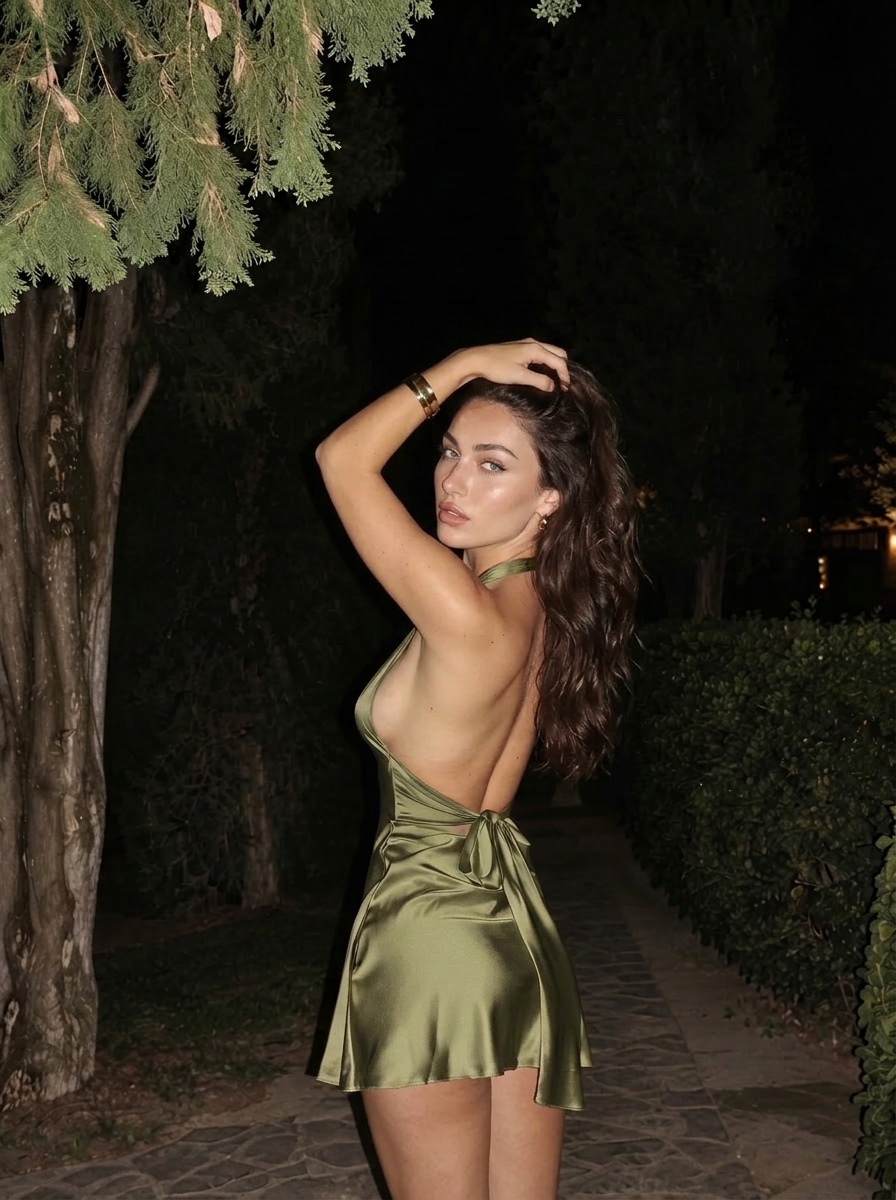
Olive satin dress outdoors
View the full NB2 prompt
A scene featuring the woman in the uploaded reference image (DO NOT TOUCH FACE). Image 1 is the identity-neutral chroma-green scene template. Image 2 is the identity reference for Lily. Facial construction: build the complete primary face solely from Lily's identity in Image 2. Image 1's perfectly blank head supplies only head position, scale, yaw, pitch, roll, and neck attachment. It supplies no face shape, facial proportions, features, gaze, or expression. Apply the Face description below to Lily's facial identity from Image 2; do not infer or average facial anatomy from Image 1. Pose authority: Image 1 controls all scene geometry. Preserve the primary subject's exact shoulder line, neck rotation, head yaw, head pitch, and head roll from Image 1 even when they differ from Image 2. The frozen Face description controls gaze and expression on the Image 2 identity. Never straighten, front-face, recenter, or otherwise normalize the head pose to match Image 2. Scene: A woman stands outdoors at night, captured from the waist up in a three-quarter view. She has her right arm raised with her hand resting on the back of her head, while her body is turned to look back over her shoulder toward the camera. Wardrobe: The subject is wearing a sleeveless, olive green satin backless mini dress with a tie-back detail. Face: The subject's head is turned toward the viewer with a neutral, relaxed expression. Her eyes are open and gazing directly at the camera, with her mouth slightly parted and brows in a natural, soft position. Wardrobe: The subject is wearing a sleeveless, olive green satin backless mini dress with a tie-back detail. Preserve every visible garment and footwear item exactly. Wardrobe geometry authority: Image 1 controls the exact neckline depth and shape, strap placement, visible cleavage and coverage, bust contour created by the garment, hem, fit, fabric tension, and overlap. Do not raise, flatten, widen, or redesign the garment. Wardrobe appearance authority: preserve the garment colors, patterns, sheen, opacity, and fabric texture visible in Image 1; never treat clothing as mannequin material. Hair authority: Image 1 controls hairstyle geometry and style, including length, silhouette, part line, root direction, volume, layered sections, bangs, braids or tied sections, wave or curl groups, separated locks, overlaps, tapered ends, and whether the hair is worn up or down. Image 2 controls the target subject's hair color and identity. Interpret every chroma-green hair section as a geometry guide, not as a solid object. Reconstruct complete photorealistic natural hair with continuous strands and fine texture while preserving the guided section placement and flow. Never return the target subject bald, and never leave a helmet, cap, slab, wedge, faceted polygon shell, or blocky low-poly hair shape. Replace only the primary chroma-green mannequin completely with Lily from Image 2. Replace every secondary chroma-green mannequin with a separate, distinct new adult identity that broadly preserves that secondary subject's visible styling, clothing state, pose, scale, and scene role. Never copy or duplicate Lily onto a secondary person. Use Image 2 exclusively for facial identity, facial proportions, skin, eye appearance, and hair color. Do not copy any normalized mannequin facial proportions as identity, and do not reconstruct the original source person's identity. Match the stated action, camera relationship, face, hand positions and interactions, visible object inventory, person count, pose, crop, clothing state, lighting, background, and composition. Do not add an implied phone, camera, mirror, held prop, person, garment, or text that the Scene does not show. Remove all chroma-green mannequin material, green spill, plastic texture, blank-face artifacts, and placeholder traces from every subject. Preserve legitimate green scene objects and clothing. Photorealistic, natural skin texture, anatomically coherent hands and body, no text.
 Open template
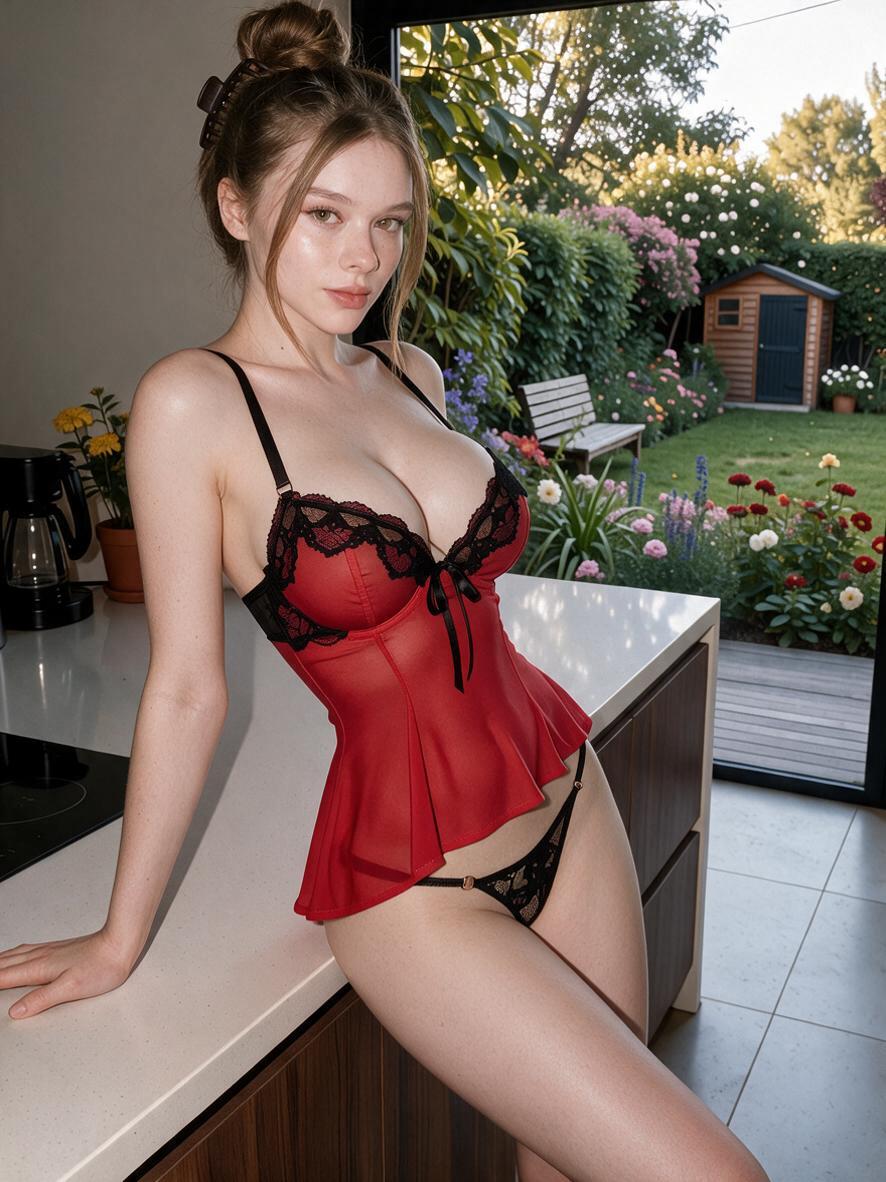
Red lace-trimmed corset in a kitchen
View the full NB2 prompt
A scene featuring the woman in the uploaded reference image (DO NOT TOUCH FACE). Image 1 is the identity-neutral chroma-green scene template. Image 2 is the identity reference for Mila. Scene: A woman stands in a kitchen leaning against a counter, facing the camera with a garden visible through a large glass door behind her. She has her right arm extended, resting her hand on the countertop, while her body is angled slightly toward the viewer. Wardrobe: The subject is partially nude, wearing a red and lace-trimmed corset top and lace thong underwear. Face: The subject has a neutral, soft expression with her head tilted slightly to her left. Her eyes are open and directed toward the camera, her brows are relaxed, and her mouth is closed. Wardrobe: The subject is partially nude, wearing a red and lace-trimmed corset top and lace thong underwear. Preserve the partially nude visible clothing state exactly. Do not add garments or censoring elements that are absent from the source scene. Replace only the primary chroma-green mannequin completely with Mila from Image 2. Replace every secondary chroma-green mannequin with a separate, distinct new adult identity that broadly preserves that secondary subject's visible styling, clothing state, pose, scale, and scene role. Never copy or duplicate Mila onto a secondary person. Use Image 2 exclusively for facial identity, facial proportions, skin, eye appearance, and hair identity. Do not copy any normalized mannequin facial proportions as identity, and do not reconstruct the original source person's identity. Match the stated action, camera relationship, face, hand positions and interactions, visible object inventory, person count, pose, crop, clothing state, lighting, background, and composition. Do not add an implied phone, camera, mirror, held prop, person, garment, or text that the Scene does not show. Remove all chroma-green mannequin material, green spill, plastic texture, blank-face artifacts, and placeholder traces from every subject. Preserve legitimate green scene objects and clothing. Photorealistic, natural skin texture, anatomically coherent hands and body, no text.
 Open template
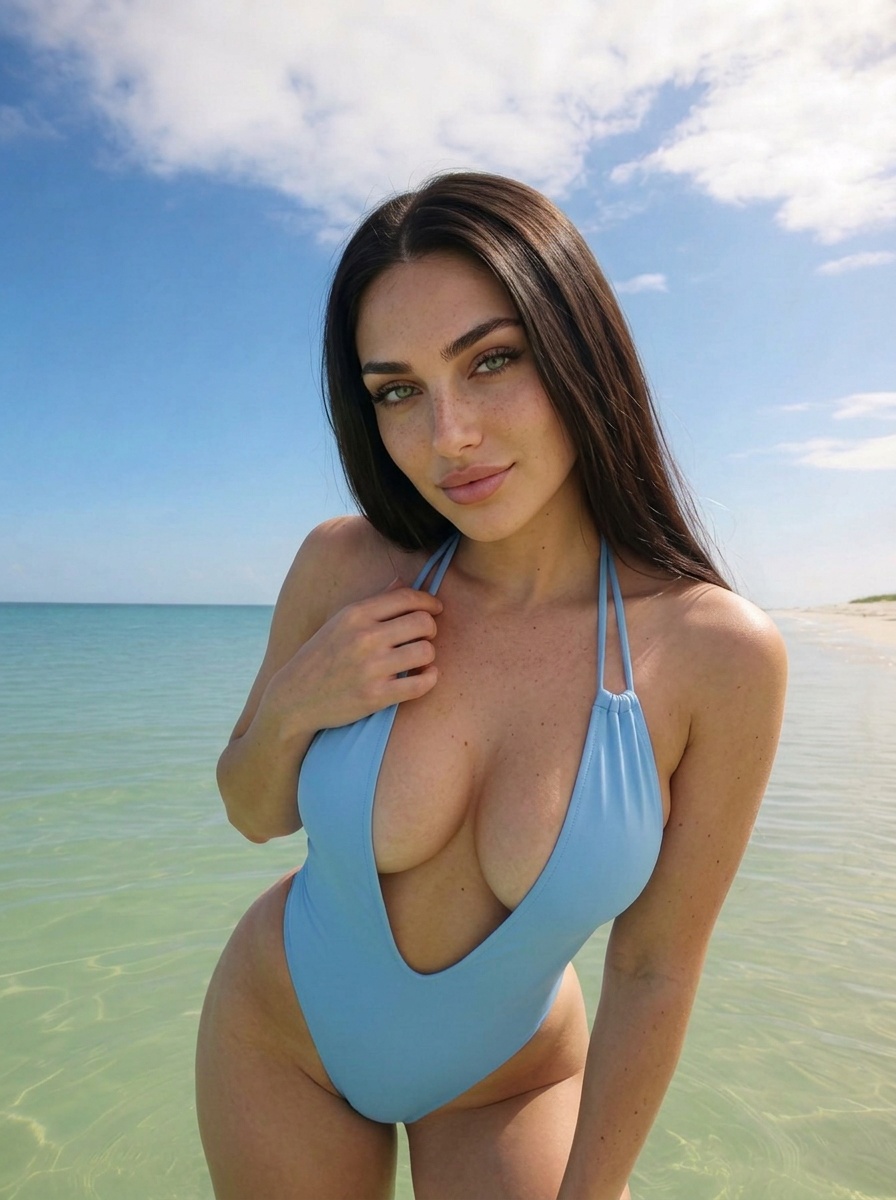
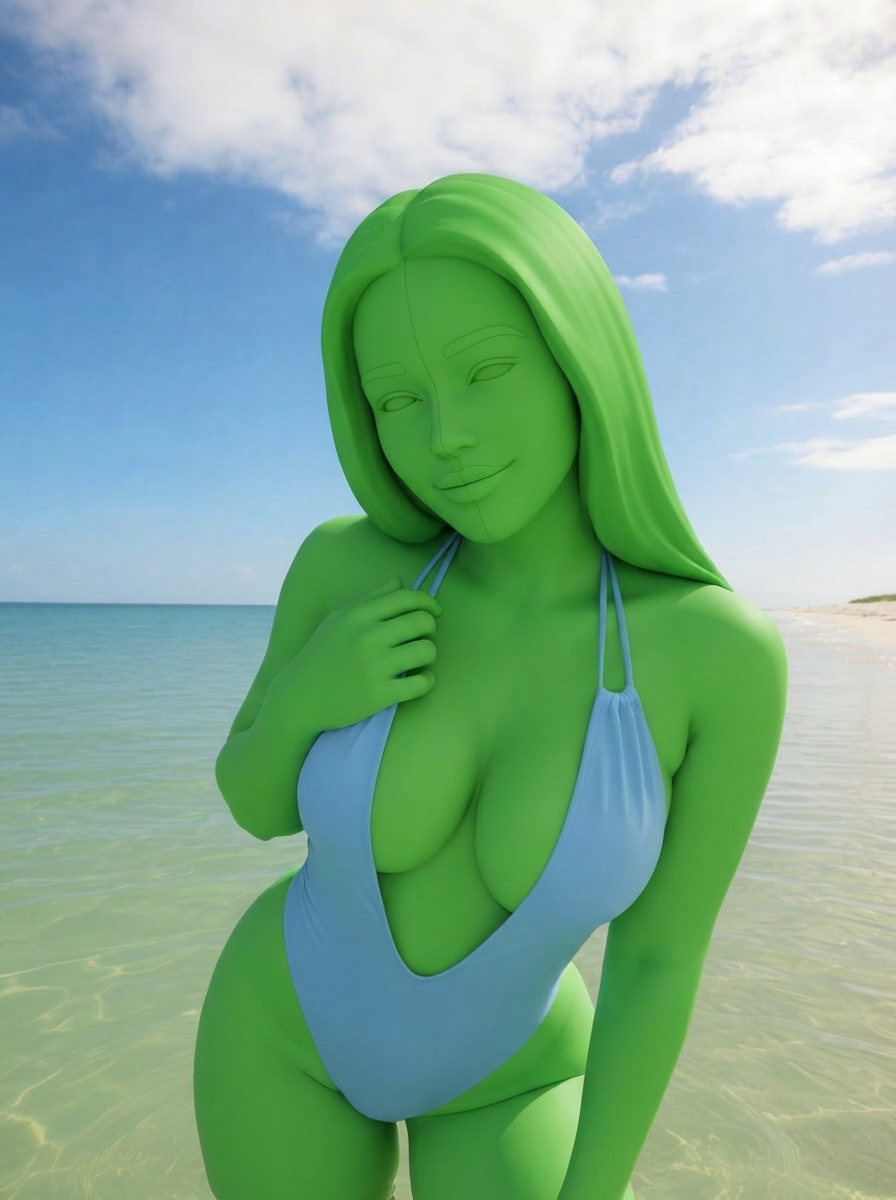
Blue swimsuit by the sea
View the full NB2 prompt
A scene featuring the person in the uploaded reference image (DO NOT TOUCH FACE). Image 1 is the identity-neutral chroma-green scene template. Image 2 is the identity reference for Lily. Pose authority: Image 1 controls all scene geometry. Preserve the primary subject's exact shoulder line, neck rotation, head yaw, head pitch, head roll, and eye-gaze direction from Image 1 even when they differ from Image 2. Image 2 controls identity only; never straighten, front-face, recenter, or otherwise normalize the head pose to match Image 2. Scene: A person stands waist-deep in clear ocean water on a sunny beach, leaning slightly forward toward the camera. Their right hand is raised to their chest, while the left arm hangs down at their side. The background features a bright blue sky and a distant shoreline. Wardrobe: The subject is wearing a light blue, deep-plunging one-piece swimsuit. Face: The subject has a slight, closed-mouth smile with a relaxed expression. Their head is tilted slightly to the viewer's left, with eyes looking directly toward the camera. Wardrobe: The subject is wearing a light blue, deep-plunging one-piece swimsuit. Preserve every visible garment and footwear item exactly. Wardrobe geometry authority: Image 1 controls the exact neckline depth and shape, strap placement, visible cleavage and coverage, bust contour created by the garment, hem, fit, fabric tension, and overlap. Do not raise, flatten, widen, or redesign the garment. Wardrobe appearance authority: preserve the garment colors, patterns, sheen, opacity, and fabric texture visible in Image 1; never treat clothing as mannequin material. Hair authority: Image 1 controls hairstyle geometry and style, including length, silhouette, part line, root direction, volume, layered sections, bangs, braids or tied sections, wave or curl groups, separated locks, overlaps, tapered ends, and whether the hair is worn up or down. Image 2 controls the target subject's hair color and identity. Interpret every chroma-green hair section as a geometry guide, not as a solid object. Reconstruct complete photorealistic natural hair with continuous strands and fine texture while preserving the guided section placement and flow. Never return the target subject bald, and never leave a helmet, cap, slab, wedge, faceted polygon shell, or blocky low-poly hair shape. Replace only the primary chroma-green mannequin completely with Lily from Image 2. Replace every secondary chroma-green mannequin with a separate, distinct new adult identity that broadly preserves that secondary subject's visible styling, clothing state, pose, scale, and scene role. Never copy or duplicate Lily onto a secondary person. Use Image 2 exclusively for facial identity, facial proportions, skin, eye appearance, and hair color. Do not copy any normalized mannequin facial proportions as identity, and do not reconstruct the original source person's identity. Match the stated action, camera relationship, face, hand positions and interactions, visible object inventory, person count, pose, crop, clothing state, lighting, background, and composition. Do not add an implied phone, camera, mirror, held prop, person, garment, or text that the Scene does not show. Remove all chroma-green mannequin material, green spill, plastic texture, blank-face artifacts, and placeholder traces from every subject. Preserve legitimate green scene objects and clothing. Photorealistic, natural skin texture, anatomically coherent hands and body, no text.
 Open template
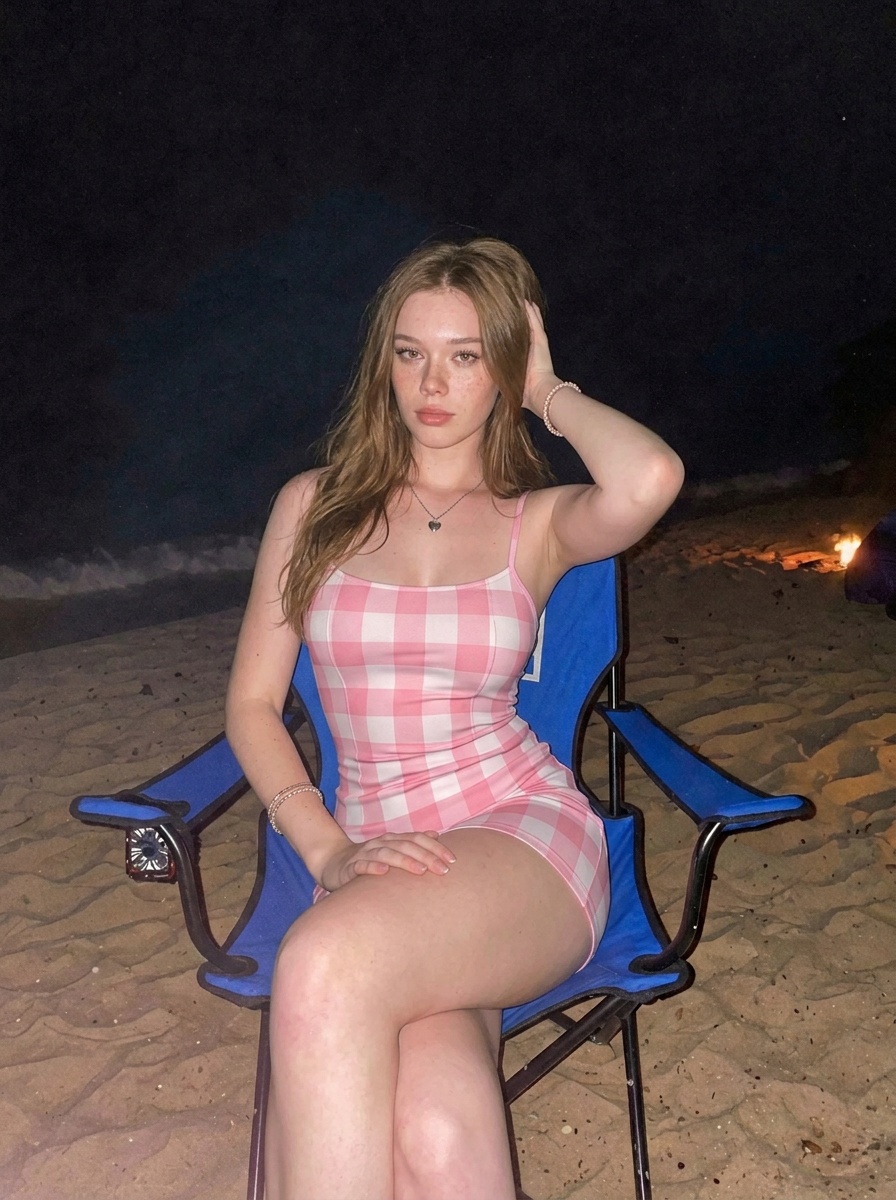
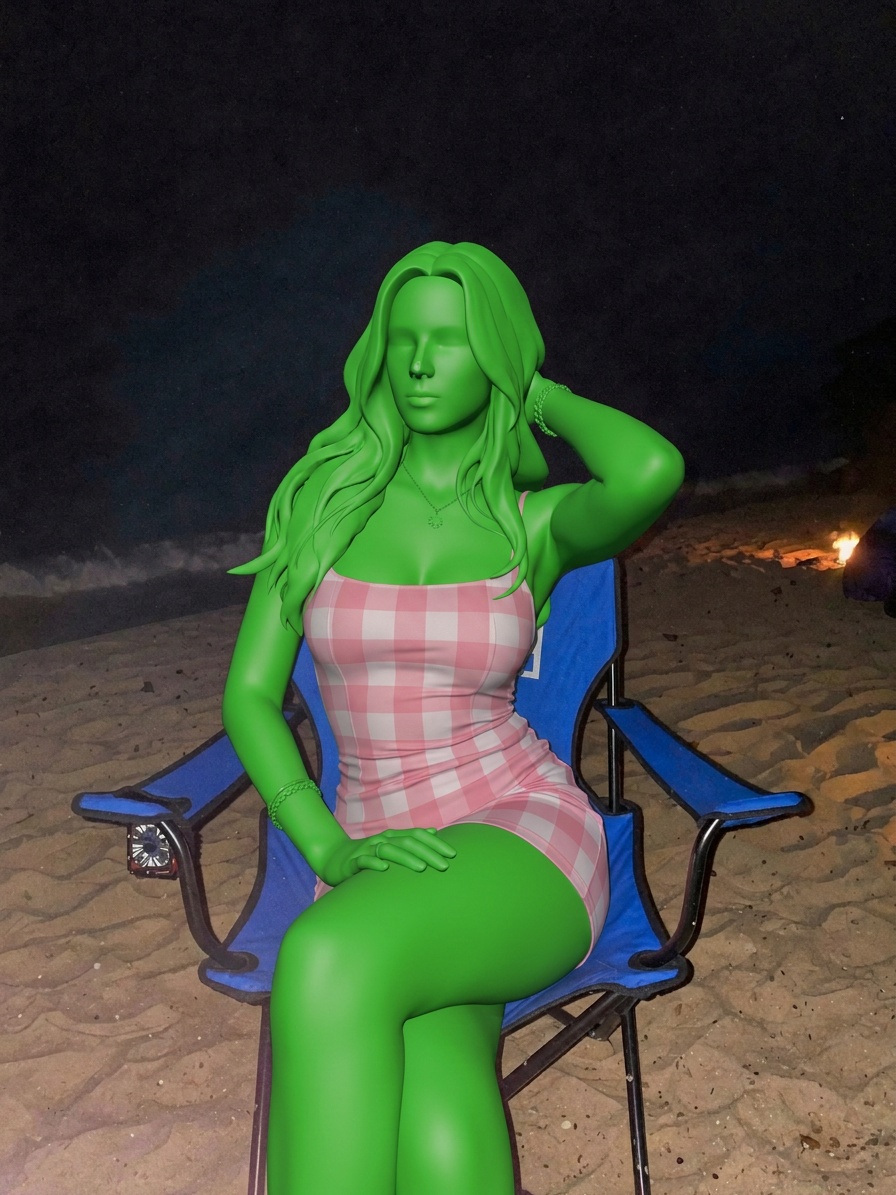
Pink gingham dress on the beach
View the full NB2 prompt
A scene featuring the woman in the uploaded reference image (DO NOT TOUCH FACE). Image 1 is the identity-neutral chroma-green scene template. Image 2 is the identity reference for Mila. Pose authority: Image 1 controls all scene geometry. Preserve the primary subject's exact shoulder line, neck rotation, head yaw, head pitch, head roll, and eye-gaze direction from Image 1 even when they differ from Image 2. Image 2 controls identity only; never straighten, front-face, recenter, or otherwise normalize the head pose to match Image 2. Scene: A woman sits in a blue folding chair on a sandy beach at night, illuminated by artificial light. She has her left hand raised to her hair and her right hand resting on her lap, with her legs crossed. Wardrobe: The subject is wearing a pink and gingham-patterned mini dress, a necklace with a pendant, and two bracelets. Face: The subject's head is tilted slightly to her left with a neutral, calm expression. Her eyes are open and looking directly at the camera, with her mouth closed and relaxed. Wardrobe: The subject is wearing a pink and gingham-patterned mini dress, a necklace with a pendant, and two bracelets. Preserve every visible garment and footwear item exactly. Wardrobe geometry authority: Image 1 controls the exact neckline depth and shape, strap placement, visible cleavage and coverage, bust contour created by the garment, hem, fit, fabric tension, and overlap. Do not raise, flatten, widen, or redesign the garment. Wardrobe appearance authority: preserve the garment colors, patterns, sheen, opacity, and fabric texture visible in Image 1; never treat clothing as mannequin material. Hair authority: Image 1 controls hairstyle geometry and style, including length, silhouette, part line, root direction, volume, layered sections, bangs, braids or tied sections, wave or curl groups, separated locks, overlaps, tapered ends, and whether the hair is worn up or down. Image 2 controls the target subject's hair color and identity. Interpret every chroma-green hair section as a geometry guide, not as a solid object. Reconstruct complete photorealistic natural hair with continuous strands and fine texture while preserving the guided section placement and flow. Never return the target subject bald, and never leave a helmet, cap, slab, wedge, faceted polygon shell, or blocky low-poly hair shape. Replace only the primary chroma-green mannequin completely with Mila from Image 2. Replace every secondary chroma-green mannequin with a separate, distinct new adult identity that broadly preserves that secondary subject's visible styling, clothing state, pose, scale, and scene role. Never copy or duplicate Mila onto a secondary person. Use Image 2 exclusively for facial identity, facial proportions, skin, eye appearance, and hair color. Do not copy any normalized mannequin facial proportions as identity, and do not reconstruct the original source person's identity. Match the stated action, camera relationship, face, hand positions and interactions, visible object inventory, person count, pose, crop, clothing state, lighting, background, and composition. Do not add an implied phone, camera, mirror, held prop, person, garment, or text that the Scene does not show. Remove all chroma-green mannequin material, green spill, plastic texture, blank-face artifacts, and placeholder traces from every subject. Preserve legitimate green scene objects and clothing. Photorealistic, natural skin texture, anatomically coherent hands and body, no text.
How we picked these
- Selected from recent Instagram remix-pipeline NB2 mannequin packs featuring Mila and Lily, with each template visually checked against its result. Pipeline sourcing does not establish Instagram publication dates.
FAQ
Why use a mannequin instead of a person as the scene reference?
The mannequin preserves the visual structure without supplying another person's face. Your separate character photo supplies identity, which helps reduce identity blending.
Can I copy the prompts for free?
Yes. Open a pack or expand its prompt here to copy it. Use the green template as Image 1 and your character photo as Image 2.
Will this make every result identical?
No. The template gives stronger visual guidance, but generation can still change the face, anatomy or outfit. Review each result before keeping it.
Related guides
Topic hubs
Browse complete prompt and model guides
Guide collections
More prompt guide collections
Continue into related Remix Camera guides grouped by use case.